Wednesday, June 23, 2010

US Siamese Twins - Kendra & Maliyah Herrin


    1) this is a miracle!

  • Kendra & Maliyah were born on 26 Feb 2002
  • Separated on August 2006
  • The girls had been born fused at the midsection, sharing a kidney, a liver, a pelvis, one set of legs and part of their intestines.
  • Doctors successfully completed 26 hours of separation and reconstruction surgery.
  • They were 4 year-old when separated.
  • Watch their updates at YouTube :http://www.youtube.com/watch?v=rwyrensj-gI

2) Abby & Brittany Hensel - another conjoined twins (NOT separated)


3) The first Siamese Twins - Chang & Eng


Wednesday, June 16, 2010

Dolphins slaughtering in Taiji, Japan


I have just watched this documentary 'The Cove'. An exciting film, with powerful message!


It is sad to know that while we are enjoying ourselves watching dolphin shows, the dolphins are suffering, they are not smiling!!. Many die during this captivity. When they can't bear the pain, they can actually commit suicide by stop breathing!


See for yourselves how this intelligent creatures are slaughtered every year in Japan from Sept to Mar. As many as 20,000 dolphins are killed, for meat. Worst still, research shows dolphins meat are highly contaminated with mercury, upto 2ooo ppm (safe level is 0.5ppm).


Dolphin meat is sold as other meat such as 'whale' meat to consumers worldwide, are you consuming dolphin meat at the japanese restaurant? you don't even know. So, pregnant women & children, stay away from the meat!

Stop the killing of dolphins!

you can get the dvd at speedy video at rm16.90, or just download from takepart at The Cove.

read more at this link: The Cove - dolphins slaughter


Thursday, June 3, 2010

Spermatogenesis & Oogenesis

Here are some useful diagrams to help you recall spermatogenesis, Oogenesis & the menstrual cycle.


1) Spermatogenesis

  • occurs in the testes of the male body at puberty.
  • sperms/spermatozoa can survive in the human female body for about 72 hours (3 days).
  • the smallest cell in the male body & it can swims by beating its tail.
  • formation of healthy sperms require 2-3 oC lower than ideal body temperature.
  • each spermatogonium will give rise to 4 genetically different funtional sperms.
2) Oogenesis
a)

  • Oogenesis is the production of ovum which occurs in the ovary of the female.
  • One oogonium will eventually produce one functional ovum/secondary oocyte & polar bodies (which hv no function in fertilisation)
  • Ovum/secondary oocyte is the biggest cell in the female body, about 0.02cm in size.
  • it couldn't move by itself & can survive for about 24 hours (one day)
  • after that, the ovum/secondary occyte is considered too old to be fertilised to produce a healthy embryo.

b) refer to your notes for comparison between oogeneis & spematogenesis.
  • In oogenesis, the cell division is interrupted at Prophase I and Metaphase II.


3) The menstrual cycle
  • ovulation (the release of secondary oocyte from the ovary) occurs at around day 14.
  • 2 groups of hormone that regulate the menstrual cycle are:
    i) pituitary hormone - FSH & LH
    ii) ovarian hormone - oestrogen & progesterone.

Tuesday, May 25, 2010

About forest farming


here are some info. on forest farming for your reading.


Introduction:
Forest farming practices can be used by private enterprise to grow desirable non-timber forest products on private lands, to supplement family income, and to allow biodiversity to reestablish within forests.

Definition:
Special forest products (SFPs) or non-timber forest products (NTFPs) are high-value specialty product items derived from green plants, fungi, invertebrates, and other organisms that inhabit forested areas.

These products fall into four general categories


  1. food (e.g., mushrooms and nuts)
  2. botanicals (e.g., herbs and medicinals - tongkat ali, ginseng, kacip fatimah)
  3. decoratives (e.g., floral greenery and dyes)
  4. handicrafts (e.g., baskets and wood products -rattan)

Concepts & Principles:

In forest farming practices, high-value specialty crops are intentionally cultivated under the protection of a forest overstory that has been modified and managed to provide the appropriate microclimate conditions.

Typically, these systems are established on private land by thinning an existing forest or woodlot to leave the best crop trees for continued wood production and to create the appropriate conditions for the understory crop to be grown.

Then, the understory crop is established and intensively managed to provide short-term income.

Planning & Design:

A forest farming practice is usually a small area of land (5 acres or less) whose vertical, horizontal, and below-ground dimensions are managed intensely to produce multiple crops simultaneously.

Systems usually focus on a single SFP plus timber, but can include several products.

Examples of systems include:

  1. ginseng + maple syrup + bee products + timber
  2. shiitake mushrooms + timber
  3. ferns + beargrass + mushrooms + timber
  4. ginseng + walnuts + black walnut veneer logs
The amount of light in the stands is altered by thinning, pruning, or adding trees.
Existing stands of trees can be intercropped with annual, perennial, or woody plants. Compatibility among understory and overstory plants and cultural methods is essential.

Benefits:

  1. Economic
    Some products especially medicinals and botanicals can have tremendous economic value, while others provide a lower but steady supplemental income.
  2. Conservation and System-Level
    Forest farming activities modify the forest ecosystem but do not significantly interfere with its crucial contributions of water capture and filtering, soil erosion control, microclimate moderation, and wildlife habitat.
    Producers should avoid harmful species and follow EPA approved guidelines for herbicides, fungicides, and insecticides.
  3. Social
    Forest farming provides opportunities to generate short-term income from existing woodlots,with minimum capital investment. Especially on small family farms, this can contribute significantly to rural economic development and diversification.

source: forest farming - An Agroforestry Practice .

Friday, May 14, 2010

Mitosis and Meiosis


Image shows karyotype of a female. Her somatic cell has a diploid number of 46.

refer to your chapter 5 note.
What is diploid number & haploid number of chromosome?
1. Diploid - organisms or cells that have 2 sets of chromosomes.
2. Haploid - cells that have only one set of chromosomes.

Here are some images which are related to cell division:

1. Image below shows the chromosomes, DNA, histone proteins inside the nucleus of a typical cell.


2. Image below shows chromosomes.
  • When the chromosome condense, coil-up and tighten during prophase of mitosis (or prophase I or prohase II of meiosis), the chromosome appear as two identical chromatids called sister chromatids attached together at the contromere.


3. Prophase I of meiosis I.
  • At the chiasma, exchange of genetic material between the non-sister chromatids of bivalent through the process of crossing over.
  • Crossing over results in new combination of genetic material and is important source of genetic variation.


4. the differences between Meiosis & Mitosis


Plant Hormone

what is coleoptile? it is a tough protective sheath that encloses/protects the tip of a shoot.
  • refer to page 22-24, chapter 3.
  • Plant hormone is a chemical substance produced by plant, which is able to influence the growth & development of the plant.
  • Plant hormones can be used to produce fruit without seeds, to ripen fruits, to increase the size of fruit, in growing cuttings, controlling weeds, etc.
  • There are 5 classes of plant hormone:
    1. Auxins (Indole Acetic Acid) - promotes cell elongation at stem tip, roots initiation, fruit development.
    2. Cytokinins - promotes cell division
    3. Gibberellins - promotes cell elongation
    4. Abscisic acid - promotes seed dormancy
    5. Ethylene (ethene) - a gas hormone which is used to ripen fruits, etc
  • Auxin is a plant hormone that controls tropic response.
  • It is produced in the apical meristem of the shoot & root.
  • Auxin diffuse from zone of cell division into zone of cell elongation where it stimulates the cell to elongate.
  • Diagram below shows:
    1. concentration of auxins needed for maximum growth of shoots will inhibit roots growth.
    2. at low concentration of auxin hormone, this promotes roots growth but cannot stimulate shoots growth.


Below are some experiments related to Auxins hormone:

1. The coleoptile tip is removed (just above the zone of cell elongation). Gelatin/agar block which contains auxin hormone is then placed at one side of the coleoptile.
Results: coleoptile bending towards the side without the agar block.


2. Role of auxins in controlling phototropism: (unilateral light)


3. Shoot placed horizontally. Auxin hormone will accumulate at the lower side.


4. Diagram below showing geotropism on shoot & root of seedling when the seedlings are placed in different positions. The shoot shows negative geotropism while the root shows positive geotropism.


Friday, April 23, 2010

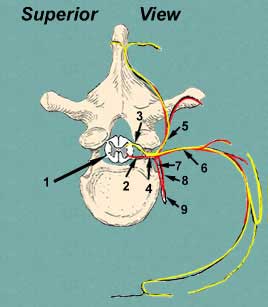
Spinal nerves

This posting about spinal nerve is not covered under spm syllabus. But i hope the diagrams below can give you some understanding about spinal nerve.

We hv 31 pairs of spinal nerves.


1 is spinal cord; 2 is ventral root; 3 is dorsal root; 4 is spinal nerve


Functional types of neurons in spinal nerves (& other nerves):

  1. somatic afferent - sensory from general cutaneous receptors (in the skin) & proprioceptors (in skeletal muscles, tendons, & joints)
  2. somatic efferent - motor to skeletal muscles
  3. visceral afferent - sensory from receptors in the viscera (smooth muscle, cardiac muscle, & glands)
  4. visceral efferent - motor to smooth muscle, cardiac muscle, & glands

    *viscera =internal organs; singular (viscus)


Wednesday, April 7, 2010

The skeletal muscle tissue


1. In general, there are 3 types of muscle tissues.
  • Skeletal muscle: which is striated and voluntary
  • Cardiac muscle: which is striated and involuntary
  • Smooth muscle: which is non striated and involuntary


2. Skeletal muscle tissue:


  • involuntary muscle (can be made contract or relax by conscious control through the nervous system)
  • striated or striped muscle because of the presence of alternating dark & light bands on the muscle fibre.

    The structure of skeletal muscle:
    1. Is made up of a large number of cylindrical cells called muscle fibres or myofibres.
    (myofibre = a muscle cell)
    2. Each myofibre/muscle fibre is covered by a plasma membrane called sarcolemma, has many nuclei, & contains many protein fibres (called myofibrils) which enable the muscle fibre to contract.
    3. Each skeletal tissue consists of bundles of muscle fibres & these bundles are separated by connective tissue (also called epimysium)


    What is myofibrils?
    1.Myofibrils are composed of individual contractile proteins called myofillaments. These myofilaments are generally divided into thick and thin myofilaments.
    2. The thin myofilaments are composed mainly of a protein known as actin. Actin filaments are anchored into the z-line of a sarcomere.
    3. The thick myofilaments are composed mainly of the protein myosin. It is the orderly overlapping of the actin and myosin filaments that give cardiac and skeletal muscle their striated appearance (light and dark bands).
  • The contraction of skeletal muscle tissue comes from the collective contractions of each single muscle fibre, whose contraction in turn comes from the contractions of the protein fibres (myofibrils).
  • The contraction of skeletal muscle requires energy (ATP) produced by mitochondria within the muscle fibres. (sarcosome = the mitochondria of muscle cell).


What is cardiac muscle?

  • Cardiac muscle cells are not as long as skeletal muscles cells and often are branched cells.
  • Cardiac muscle cells may be mononucleated or binucleated. In either case the nuclei are located centrally in the cell.
  • Cardiac muscle is also striated.
  • In addition cardiac muscle contains intercalated discs.

What is smooth muscle?

  • Smooth muscle cells are described as spindle shaped. That is they are wide in the middle and narrow to almost a point at both ends.
  • Smooth muscle cells have a single centrally located nucleus.
  • Smooth muscle cells do not have visible striations although they do contain the same contractile proteins as skeletal and cardiac muscle, these proteins are just laid out in a different pattern.

Friday, April 2, 2010

Production of Proteins/Enzymes

This is a useful video to bring you through the production of proteins/enzyme.

For SPM level, your notes (form 4 chapter 2 & 4) regarding the production of Extracellular Enzyme are sufficient. Terms such as transcription, translation are not covered under spm syllabus.


Thursday, April 1, 2010

Synapse & transmission of information


What is synapse?
- it is the site where 2 neurones, or a neurone & an effector cell communicate.

Nerve impulses must cross the synapse in order to carry NI/information along to another neurone. Chemicals are used by a neurone to trasmit an impulse across a synapse.
How transmission of chemical signals across the synapse? (refer notes pg7, #6, memorise this!)
Transmission of NI across synapse is an active process/transport which requires energy/ATP. therefore, the synaptic knob contains abundant of mitochondria for generation of energy.

*pls note that action potential, calcium, sodium ion channels, endocytosis are not covered under spm syllabus.