Paper 2 set 1
Paper 2 set 2
Paper 3 set 1 question
Paper 3 set 1
Paper 3 set 2 question
Paper 3 set 2
Sunday, November 23, 2014
Saturday, November 22, 2014
2014 MRSM Paper 1 and 2
MRSM Paper 1
MRSM Paper 2
MRSM SKEMA
On behalf of my students, I would like to thank Cikgu Muhammad Azrie bin M Raymi who make this sharing of knowledge possible. Terima Kasih Cikgu.
MRSM Paper 2
MRSM SKEMA
On behalf of my students, I would like to thank Cikgu Muhammad Azrie bin M Raymi who make this sharing of knowledge possible. Terima Kasih Cikgu.

Saturday, November 23, 2013
2013 Trial Biology SPM Paper 123
Dear students,
Here are the links to some 2013 state trial papers, pls take note that it is highly important for you to practise on MRSM paper 2!
1) for MRSM paper, click here for P23, click here for P1, click here for answer scheme.
2) for SBP, Kedah, N9, Terengganu papers, click here
3) for Pulau Pinang paper, click here for question & answer papers.
All the best!
from teacher Sharon
Sources:
www.bumigemilang.com,
www.myschoolchildren.com
Here are the links to some 2013 state trial papers, pls take note that it is highly important for you to practise on MRSM paper 2!
1) for MRSM paper, click here for P23, click here for P1, click here for answer scheme.
2) for SBP, Kedah, N9, Terengganu papers, click here
3) for Pulau Pinang paper, click here for question & answer papers.
All the best!
from teacher Sharon
Sources:
www.bumigemilang.com,
www.myschoolchildren.com
2012 BIOLOGY SPM TRIAL questions & answers
Dear students,
As you are aware, I have 2 blogs which I hardly update nowadays due to my busy schedule, therefore I lost the passwords to both blogs. After many attempts, I have finally get myself login back to my first blog.
For 2012 biology spm trial papers and questions, pls visit my second blog. www.merebooks.blogspot.com
All the best!
from teacher sharon
As you are aware, I have 2 blogs which I hardly update nowadays due to my busy schedule, therefore I lost the passwords to both blogs. After many attempts, I have finally get myself login back to my first blog.
For 2012 biology spm trial papers and questions, pls visit my second blog. www.merebooks.blogspot.com
All the best!
from teacher sharon
Sunday, October 23, 2011
2011 Trial Biology Paper 123
Dear my students,
Below are some of the biology trial papers which we did not have time to discuss in class, i hope you could find time to practise them before your final spm.
1) sbp - paper 123
2) mrsm - paper1, paper2, paper3 or all paper 123
- p1 answer,
3) kedah - paper 123
4) perak - p2Q, p2Answer, p3Q, p3Answer
5) kelantan - p1, p2Q&A, p3Q ,p3Q&A,
6) terengganu - p3 Q, p3 Answer
7) melaka - p2Q&A
8) pahang - p123Q&A
9) johor - p2Q, p2Answer, p3Q, p3Answer
10) negeri sembilan - p2Q, p2Answer
11) sabah
12) sarawak
The original papers can be found on http://www.edu.joshuatly.com/, http://www.bumigemilang.com/, http://www.banksoalanspm.com/, http://www.myschoolchildren.com/.
I wish all of you the very best in your spm examination & in your future undertakings.
take care
rgds,
sharon
Below are some of the biology trial papers which we did not have time to discuss in class, i hope you could find time to practise them before your final spm.
1) sbp - paper 123
2) mrsm - paper1, paper2, paper3 or all paper 123
- p1 answer,
3) kedah - paper 123
4) perak - p2Q, p2Answer, p3Q, p3Answer
5) kelantan - p1, p2Q&A, p3Q ,p3Q&A,
6) terengganu - p3 Q, p3 Answer
7) melaka - p2Q&A
8) pahang - p123Q&A
9) johor - p2Q, p2Answer, p3Q, p3Answer
10) negeri sembilan - p2Q, p2Answer
11) sabah
12) sarawak
The original papers can be found on http://www.edu.joshuatly.com/, http://www.bumigemilang.com/, http://www.banksoalanspm.com/, http://www.myschoolchildren.com/.
I wish all of you the very best in your spm examination & in your future undertakings.
take care
rgds,
sharon
Wednesday, December 8, 2010
What's after SPM - a good read

Hi all,.......Perhaps after your spm ended this december, go get this book....& read it.


".......101 young Malaysians were united by a call to reveal and describe defining moments in their lives after SPM. As young Malaysians, we all worry about not getting scholarships or being accepted into our desired universities. Many wonder and agonize over which course suits them best."
What’s After SPM is now available at MPH, Kinokuniya and Borders nationwide! The ISBN is 9789834485412 at rm19.90.
all the best!
sharon
Wednesday, December 1, 2010
An introduction :How to choose quadrat size and shape?

Dear students,
To learn more about population ecology, herewith the link you can learn more on what quadrat size (10cm x 10cm, 0.5m x 0.5m, 1m x 1m, 10m x 10m?) and what quadrat shape (square, circle or rectangle?) to use. Hopes these are helpful.
all the best
rgds
sharon
Wednesday, June 30, 2010
Can you choose your child's gender? Yes, you can, but would you do this?
click here for my older post on gender selection.
Wednesday, June 23, 2010
US Siamese Twins - Kendra & Maliyah Herrin


- 1) this is a miracle!
- Kendra & Maliyah were born on 26 Feb 2002
- Separated on August 2006
- The girls had been born fused at the midsection, sharing a kidney, a liver, a pelvis, one set of legs and part of their intestines.
- Doctors successfully completed 26 hours of separation and reconstruction surgery.
- They were 4 year-old when separated.
- Watch their updates at YouTube :http://www.youtube.com/watch?v=rwyrensj-gI
2) Abby & Brittany Hensel - another conjoined twins (NOT separated)
3) The first Siamese Twins - Chang & Eng
Wednesday, June 16, 2010
Dolphins slaughtering in Taiji, Japan


I have just watched this documentary 'The Cove'. An exciting film, with powerful message!
It is sad to know that while we are enjoying ourselves watching dolphin shows, the dolphins are suffering, they are not smiling!!. Many die during this captivity. When they can't bear the pain, they can actually commit suicide by stop breathing!
See for yourselves how this intelligent creatures are slaughtered every year in Japan from Sept to Mar. As many as 20,000 dolphins are killed, for meat. Worst still, research shows dolphins meat are highly contaminated with mercury, upto 2ooo ppm (safe level is 0.5ppm).
Dolphin meat is sold as other meat such as 'whale' meat to consumers worldwide, are you consuming dolphin meat at the japanese restaurant? you don't even know. So, pregnant women & children, stay away from the meat!
Stop the killing of dolphins!
you can get the dvd at speedy video at rm16.90, or just download from takepart at The Cove.
read more at this link: The Cove - dolphins slaughter
Thursday, June 3, 2010
Spermatogenesis & Oogenesis
Here are some useful diagrams to help you recall spermatogenesis, Oogenesis & the menstrual cycle.
1) Spermatogenesis
a)
b) refer to your notes for comparison between oogeneis & spematogenesis.

3) The menstrual cycle

1) Spermatogenesis

- occurs in the testes of the male body at puberty.
- sperms/spermatozoa can survive in the human female body for about 72 hours (3 days).
- the smallest cell in the male body & it can swims by beating its tail.
- formation of healthy sperms require 2-3 oC lower than ideal body temperature.
- each spermatogonium will give rise to 4 genetically different funtional sperms.
a)

- Oogenesis is the production of ovum which occurs in the ovary of the female.
- One oogonium will eventually produce one functional ovum/secondary oocyte & polar bodies (which hv no function in fertilisation)
- Ovum/secondary oocyte is the biggest cell in the female body, about 0.02cm in size.
- it couldn't move by itself & can survive for about 24 hours (one day)
- after that, the ovum/secondary occyte is considered too old to be fertilised to produce a healthy embryo.
b) refer to your notes for comparison between oogeneis & spematogenesis.
- In oogenesis, the cell division is interrupted at Prophase I and Metaphase II.

3) The menstrual cycle
- ovulation (the release of secondary oocyte from the ovary) occurs at around day 14.
- 2 groups of hormone that regulate the menstrual cycle are:
i) pituitary hormone - FSH & LH
ii) ovarian hormone - oestrogen & progesterone.

Tuesday, May 25, 2010
About forest farming

here are some info. on forest farming for your reading.

Introduction:
Forest farming practices can be used by private enterprise to grow desirable non-timber forest products on private lands, to supplement family income, and to allow biodiversity to reestablish within forests.
Definition:
Special forest products (SFPs) or non-timber forest products (NTFPs) are high-value specialty product items derived from green plants, fungi, invertebrates, and other organisms that inhabit forested areas.
These products fall into four general categories
- food (e.g., mushrooms and nuts)
- botanicals (e.g., herbs and medicinals - tongkat ali, ginseng, kacip fatimah)
- decoratives (e.g., floral greenery and dyes)
- handicrafts (e.g., baskets and wood products -rattan)

Concepts & Principles:
In forest farming practices, high-value specialty crops are intentionally cultivated under the protection of a forest overstory that has been modified and managed to provide the appropriate microclimate conditions.
Typically, these systems are established on private land by thinning an existing forest or woodlot to leave the best crop trees for continued wood production and to create the appropriate conditions for the understory crop to be grown.
Then, the understory crop is established and intensively managed to provide short-term income.
Planning & Design:
A forest farming practice is usually a small area of land (5 acres or less) whose vertical, horizontal, and below-ground dimensions are managed intensely to produce multiple crops simultaneously.
Systems usually focus on a single SFP plus timber, but can include several products.
Examples of systems include:
- ginseng + maple syrup + bee products + timber
- shiitake mushrooms + timber
- ferns + beargrass + mushrooms + timber
- ginseng + walnuts + black walnut veneer logs
The amount of light in the stands is altered by thinning, pruning, or adding trees.
Existing stands of trees can be intercropped with annual, perennial, or woody plants. Compatibility among understory and overstory plants and cultural methods is essential.
Existing stands of trees can be intercropped with annual, perennial, or woody plants. Compatibility among understory and overstory plants and cultural methods is essential.
Benefits:
- Economic
Some products especially medicinals and botanicals can have tremendous economic value, while others provide a lower but steady supplemental income. - Conservation and System-Level
Forest farming activities modify the forest ecosystem but do not significantly interfere with its crucial contributions of water capture and filtering, soil erosion control, microclimate moderation, and wildlife habitat.
Producers should avoid harmful species and follow EPA approved guidelines for herbicides, fungicides, and insecticides. - Social
Forest farming provides opportunities to generate short-term income from existing woodlots,with minimum capital investment. Especially on small family farms, this can contribute significantly to rural economic development and diversification.
Friday, May 14, 2010
Mitosis and Meiosis

Image shows karyotype of a female. Her somatic cell has a diploid number of 46.
refer to your chapter 5 note.
What is diploid number & haploid number of chromosome?
1. Diploid - organisms or cells that have 2 sets of chromosomes.
2. Haploid - cells that have only one set of chromosomes.
What is diploid number & haploid number of chromosome?
1. Diploid - organisms or cells that have 2 sets of chromosomes.
2. Haploid - cells that have only one set of chromosomes.
Here are some images which are related to cell division:
1. Image below shows the chromosomes, DNA, histone proteins inside the nucleus of a typical cell.

2. Image below shows chromosomes.
- When the chromosome condense, coil-up and tighten during prophase of mitosis (or prophase I or prohase II of meiosis), the chromosome appear as two identical chromatids called sister chromatids attached together at the contromere.

3. Prophase I of meiosis I.
- At the chiasma, exchange of genetic material between the non-sister chromatids of bivalent through the process of crossing over.
- Crossing over results in new combination of genetic material and is important source of genetic variation.

4. the differences between Meiosis & Mitosis

Plant Hormone

what is coleoptile? it is a tough protective sheath that encloses/protects the tip of a shoot.
- refer to page 22-24, chapter 3.
- Plant hormone is a chemical substance produced by plant, which is able to influence the growth & development of the plant.
- Plant hormones can be used to produce fruit without seeds, to ripen fruits, to increase the size of fruit, in growing cuttings, controlling weeds, etc.
- There are 5 classes of plant hormone:
1. Auxins (Indole Acetic Acid) - promotes cell elongation at stem tip, roots initiation, fruit development.
2. Cytokinins - promotes cell division
3. Gibberellins - promotes cell elongation
4. Abscisic acid - promotes seed dormancy
5. Ethylene (ethene) - a gas hormone which is used to ripen fruits, etc - Auxin is a plant hormone that controls tropic response.
- It is produced in the apical meristem of the shoot & root.
- Auxin diffuse from zone of cell division into zone of cell elongation where it stimulates the cell to elongate.
- Diagram below shows:
1. concentration of auxins needed for maximum growth of shoots will inhibit roots growth.
2. at low concentration of auxin hormone, this promotes roots growth but cannot stimulate shoots growth.

Below are some experiments related to Auxins hormone:
1. The coleoptile tip is removed (just above the zone of cell elongation). Gelatin/agar block which contains auxin hormone is then placed at one side of the coleoptile.
Results: coleoptile bending towards the side without the agar block.

2. Role of auxins in controlling phototropism: (unilateral light)

3. Shoot placed horizontally. Auxin hormone will accumulate at the lower side.

4. Diagram below showing geotropism on shoot & root of seedling when the seedlings are placed in different positions. The shoot shows negative geotropism while the root shows positive geotropism.

Friday, April 23, 2010
Spinal nerves
This posting about spinal nerve is not covered under spm syllabus. But i hope the diagrams below can give you some understanding about spinal nerve.
We hv 31 pairs of spinal nerves.

1 is spinal cord; 2 is ventral root; 3 is dorsal root; 4 is spinal nerve


We hv 31 pairs of spinal nerves.
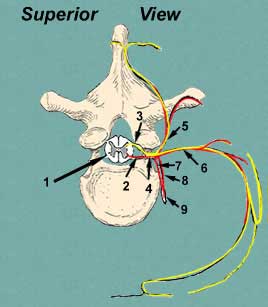
1 is spinal cord; 2 is ventral root; 3 is dorsal root; 4 is spinal nerve


Functional types of neurons in spinal nerves (& other nerves):
- somatic afferent - sensory from general cutaneous receptors (in the skin) & proprioceptors (in skeletal muscles, tendons, & joints)
- somatic efferent - motor to skeletal muscles
- visceral afferent - sensory from receptors in the viscera (smooth muscle, cardiac muscle, & glands)
- visceral efferent - motor to smooth muscle, cardiac muscle, & glands
*viscera =internal organs; singular (viscus)

Wednesday, April 7, 2010
The skeletal muscle tissue

1. In general, there are 3 types of muscle tissues.
- Skeletal muscle: which is striated and voluntary
- Cardiac muscle: which is striated and involuntary
- Smooth muscle: which is non striated and involuntary
2. Skeletal muscle tissue:

- involuntary muscle (can be made contract or relax by conscious control through the nervous system)
- striated or striped muscle because of the presence of alternating dark & light bands on the muscle fibre.
The structure of skeletal muscle:
1. Is made up of a large number of cylindrical cells called muscle fibres or myofibres.
(myofibre = a muscle cell)
2. Each myofibre/muscle fibre is covered by a plasma membrane called sarcolemma, has many nuclei, & contains many protein fibres (called myofibrils) which enable the muscle fibre to contract.
3. Each skeletal tissue consists of bundles of muscle fibres & these bundles are separated by connective tissue (also called epimysium)
What is myofibrils?
1.Myofibrils are composed of individual contractile proteins called myofillaments. These myofilaments are generally divided into thick and thin myofilaments.
2. The thin myofilaments are composed mainly of a protein known as actin. Actin filaments are anchored into the z-line of a sarcomere.
3. The thick myofilaments are composed mainly of the protein myosin. It is the orderly overlapping of the actin and myosin filaments that give cardiac and skeletal muscle their striated appearance (light and dark bands). - The contraction of skeletal muscle tissue comes from the collective contractions of each single muscle fibre, whose contraction in turn comes from the contractions of the protein fibres (myofibrils).
- The contraction of skeletal muscle requires energy (ATP) produced by mitochondria within the muscle fibres. (sarcosome = the mitochondria of muscle cell).

What is cardiac muscle?
- Cardiac muscle cells are not as long as skeletal muscles cells and often are branched cells.
- Cardiac muscle cells may be mononucleated or binucleated. In either case the nuclei are located centrally in the cell.
- Cardiac muscle is also striated.
- In addition cardiac muscle contains intercalated discs.
What is smooth muscle?
- Smooth muscle cells are described as spindle shaped. That is they are wide in the middle and narrow to almost a point at both ends.
- Smooth muscle cells have a single centrally located nucleus.
- Smooth muscle cells do not have visible striations although they do contain the same contractile proteins as skeletal and cardiac muscle, these proteins are just laid out in a different pattern.
Friday, April 2, 2010
Production of Proteins/Enzymes
This is a useful video to bring you through the production of proteins/enzyme.
For SPM level, your notes (form 4 chapter 2 & 4) regarding the production of Extracellular Enzyme are sufficient. Terms such as transcription, translation are not covered under spm syllabus.
For SPM level, your notes (form 4 chapter 2 & 4) regarding the production of Extracellular Enzyme are sufficient. Terms such as transcription, translation are not covered under spm syllabus.
Thursday, April 1, 2010
Synapse & transmission of information


What is synapse?
- it is the site where 2 neurones, or a neurone & an effector cell communicate.
Nerve impulses must cross the synapse in order to carry NI/information along to another neurone. Chemicals are used by a neurone to trasmit an impulse across a synapse.
- it is the site where 2 neurones, or a neurone & an effector cell communicate.
Nerve impulses must cross the synapse in order to carry NI/information along to another neurone. Chemicals are used by a neurone to trasmit an impulse across a synapse.
How transmission of chemical signals across the synapse? (refer notes pg7, #6, memorise this!)
Transmission of NI across synapse is an active process/transport which requires energy/ATP. therefore, the synaptic knob contains abundant of mitochondria for generation of energy.
*pls note that action potential, calcium, sodium ion channels, endocytosis are not covered under spm syllabus.
*pls note that action potential, calcium, sodium ion channels, endocytosis are not covered under spm syllabus.
Monday, March 22, 2010
What cloning is? Can we clone human?

- It is a highly artificial form of asexual reproduction based on mitosis to form new individuals.
- The new individuals are called CLONES, which have the same genetic material as the parent.
How is animal cloning carried out?
- An animal is cloned using a nucleus obtained from an adult tissue.
- The clone is genetically identical to the somatic cell donor.
- In 1996, Scotland , Dolly became the first cloned sheep done through a technique called Somatic Cell Nuclear Transplant (SCNT). She was produced after 270 attempts & has many deformities. She died of lung disease in 2003 at the age of 6, while a normal life span of a sheep is around 10-16 years.
To know more about cloning, watch the video below or click here.
Human embryo cloning – 3 minutes
FIRST HUMAN EMBRYO-CLONE CREATED
Uploaded by neverknwo. - Explore more science and tech videos.

You can watch Dolly, the clone sheep, go to 5-7 minutes of the 2nd video below.
To watch the full documentary, click the video below or click here
Panayiotis Zavos is a controversial fertility doctor. He said to “The Independent” that he had already cloned human embryos and transferred 11 of them into the wombs of four women who had been prepared to give birth to cloned babies.
Since cloning embryos into the human womb is a criminal offense in most countries, Dr. Panayiotis Zavos is said to have worked at a secret laboratory in the Middle East where there is no cloning ban.
Dr. Zavos also revealed that he has produced cloned embryos of three dead people, including a 10-year-old child called Cady, who died in a car crash. He did so after being asked by grieving relatives if he could create biological clones of their loved one.>
Human cloning – 45 minutes
Do you think we should be cloning human?
Subscribe to:
Posts (Atom)